Acid Basic and Salt
4.Explain the reaction between lead nitrate solution and potassium iodide.
Answer:
Take lead nitrate solution in a test tube. Add potassium iodide into it and shake well. We observe the formation of a new yellow solid substance called lead iodide. During this process, another new substance called potassium nitrate is also formed.
This compound remains in solution. The reaction between lead nitrate and potassium iodide is a chemical change that results in the formation of new substances.

reaction between lead nitrate solution and potassium
5.Explain the reaction between zinc and dilute sulphonic acid.
Answer:
Take a few pieces of zinc granules in a small conical flask. Pour dilute sulphuric acid into the flask. The reaction begins immediately forming zinc sulphate and hydrogen gas. This is an example of a chemical change because new substances are formed during this reaction.

reaction between zinc and dilute sulphonic acid
Check here-Karnataka State SSLC Board Science Important Questions and Answers- SSLC Tips
6.What is a chemical change? Give two examples of chemical changes in daily life.
Answer:
Any change in a substance or substances that results in the formation of one or more new substances is called a chemical change. Burning of fuels, respiration, rusting of iron etc., are examples of chemical change.
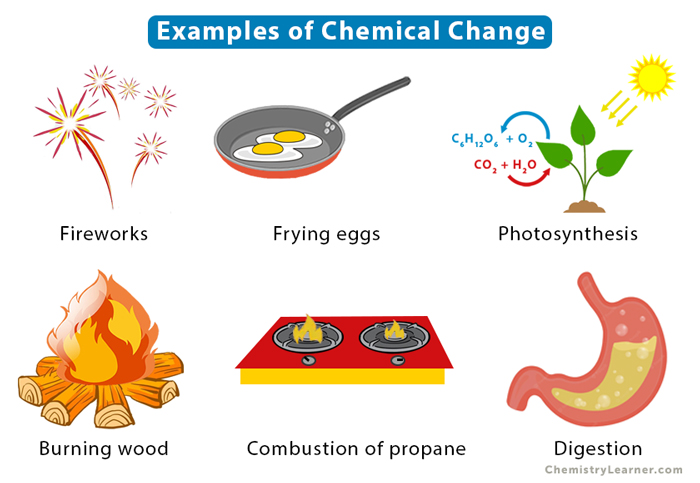
examples of chemical changes in daily life
7.Describe the reaction between calcium oxide and water.
Answer:
Take a small amount of calcium oxide (quick lime) in a beaker. Slowly add water to it. A vigorous reaction takes place and the beaker becomes wanner. This is a chemical reaction during which calcium hydroxide is formed along with the liberation of heat.
Thus we may say that water reacts with calcium oxide forming calcium hydroxide along with the liberation of heat.

reaction between calcium oxide and water
8.What changes can be generally observed during a chemical reaction?
Answer:
One or more of the following changes are generally observed during a chemical reaction:
change in state
change in color
evolution of a gas
change in temperature.

chemical reaction
Check here SSLC -Karnataka SSLC Science Syllabus 2025-26 With PDF, Check for Official Syllabus
 Support Us