Introduction
In a country where politics dominates everyday conversations, election campaigns often revolve around charismatic leaders, grand promises, and fierce ideological battles. Yet, in a surprising twist that has captivated millions of Indians online, one of the most talked-about political movements in recent months does not revolve around a seasoned politician or a rising youth leader.
Instead, it revolves around a cockroach.

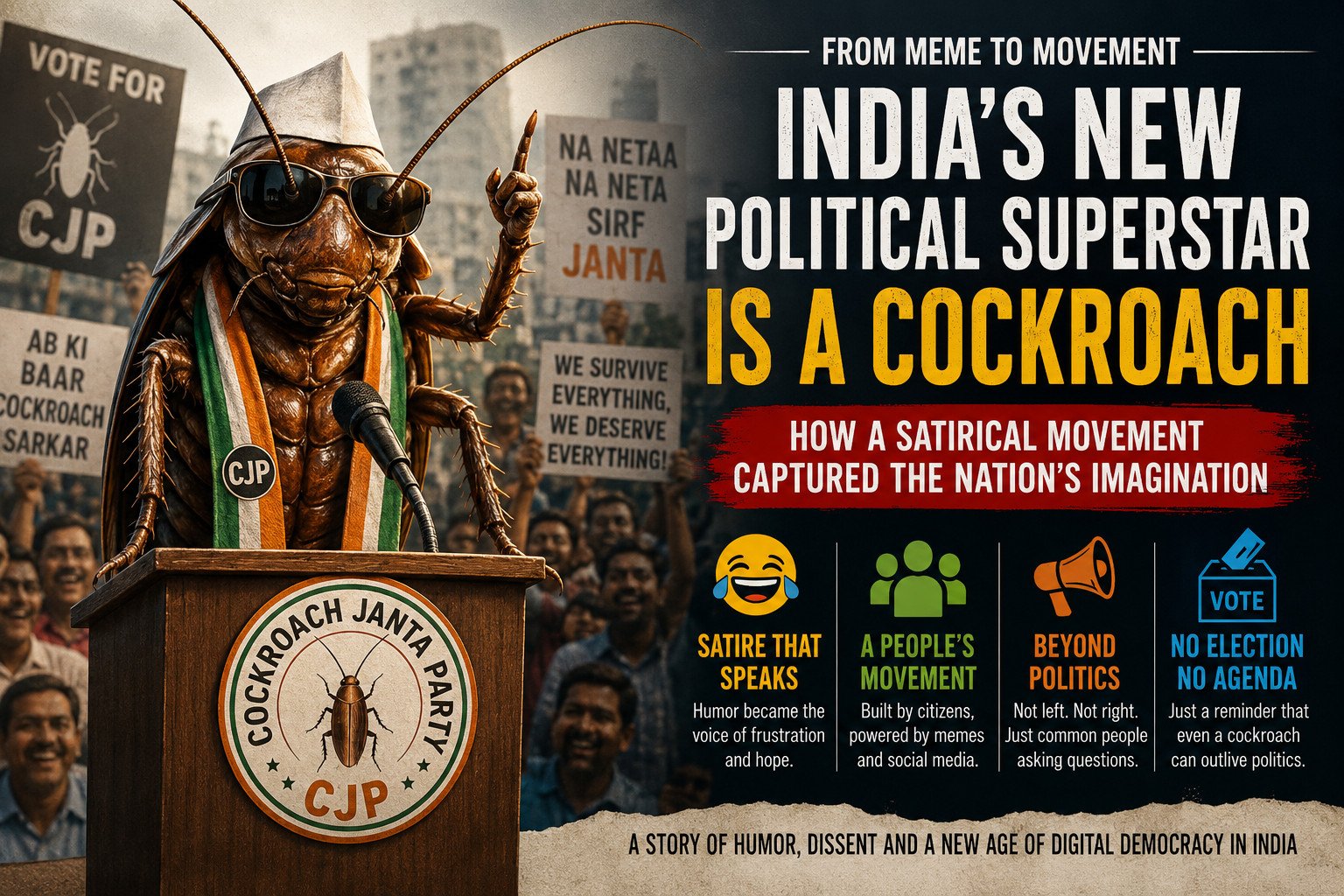
What began as an internet joke has evolved into one of India’s most fascinating social media phenomena. The Cockroach Janta Party (CJP), a satirical political movement, has emerged as a symbol of public frustration, political humor, and digital-age activism. While it is not a registered political party and has no intention of contesting elections, its rapid rise highlights a growing appetite among Indians for alternative ways of expressing political opinions.
The movement’s popularity reflects not only the power of social media but also the changing nature of political engagement among younger generations.
The Birth of the Cockroach Janta Party
The idea behind the Cockroach Janta Party is both simple and provocative.
Cockroaches are among the most resilient creatures on Earth. They survive difficult conditions, adapt quickly, and seem impossible to eliminate. For the creators of the movement, these characteristics became a metaphor for ordinary citizens who continue to endure political uncertainty, economic challenges, and social pressures regardless of which party is in power.
The movement was founded as a humorous online initiative, using satire to comment on India’s political landscape. Through memes, short videos, digital posters, and witty social media posts, the Cockroach Janta Party quickly attracted attention from people across different political backgrounds.
Unlike traditional political organizations, the movement does not ask supporters to join a formal structure. Instead, it thrives on participation, creativity, and shared humor.
Why the Idea Resonated
Political satire has always been a powerful tool for public commentary. However, the digital era has transformed satire from newspaper cartoons into viral content capable of reaching millions within hours.
The Cockroach Janta Party tapped into a sentiment that many citizens already felt: disappointment with political polarization and frustration with endless partisan conflicts.
For many supporters, the movement represents a rejection of rigid political identities. Rather than supporting one side against another, participants use humor to highlight problems that affect everyone.
This approach has allowed the movement to attract people from diverse backgrounds, including students, young professionals, content creators, and politically aware citizens who may not actively engage with conventional politics.
Social Media: The Engine Behind the Movement
The rapid growth of the Cockroach Janta Party would have been impossible without social media platforms.
Through clever branding and relatable content, the movement built an online community that thrives on interaction. Memes comparing politicians to cockroaches, satirical campaign promises, and fictional political manifestos quickly gained traction.
The movement’s creators understood an important truth about modern communication: people are more likely to share content that entertains them than content that lectures them.
By packaging political commentary within humor, the Cockroach Janta Party achieved something many traditional campaigns struggle to accomplish—it captured attention without demanding ideological commitment.
In an age where attention is one of the most valuable currencies, that achievement cannot be underestimated.
Shri H. D. Deve Gowda on His Birthday: A Legacy of Simplicity, Service, and Statesmanship
Beyond Humor: A Reflection of Public Mood
Although the movement presents itself as satire, its popularity reveals deeper social realities.
Across democracies worldwide, younger citizens increasingly express political opinions through unconventional channels. Rather than attending rallies or joining political parties, they engage through online communities, memes, podcasts, and digital campaigns.
The Cockroach Janta Party reflects this broader transformation.
Its success suggests that many people feel disconnected from traditional political structures. Humor becomes a way to discuss serious issues without becoming trapped in ideological battles.
The movement’s message resonates because it speaks to shared experiences rather than party loyalty. Rising living costs, employment concerns, governance challenges, and political fatigue are themes that transcend electoral boundaries.
The Psychology of Political Satire
Experts have long argued that satire serves an important social function. It allows people to criticize authority, challenge accepted narratives, and discuss sensitive issues in a less confrontational way.
In highly polarized environments, humor can create space for conversations that might otherwise become hostile.
The Cockroach Janta Party demonstrates this phenomenon perfectly. Its supporters are not necessarily united by a common political ideology. Instead, they are connected by a shared appreciation for satire and a desire to question political norms.
By laughing at political systems, people often reveal what they find frustrating about them.
Munirathna says dk shivakumar has disguised itself as hinduism to scare cm congress
Can Satirical Movements Influence Real Politics?
History shows that satire can have a significant impact on public discourse.
While satirical movements rarely transform directly into electoral forces, they often influence conversations, shape public perception, and highlight issues ignored by mainstream politics.
The Cockroach Janta Party may never contest an election, but its cultural influence is already evident. Media organizations, political observers, and social commentators have begun discussing the movement as an example of how political engagement is evolving in India.
Its popularity demonstrates that citizens are looking for new ways to participate in democratic discussions beyond traditional party structures.
A New Era of Digital Democracy
The rise of the Cockroach Janta Party illustrates a broader shift in how political communities form online.
Digital platforms have lowered the barriers to participation. Individuals no longer need large organizations, substantial funding, or political connections to build influential movements. A creative idea, a compelling narrative, and an engaged audience can be enough to generate national attention.
This democratization of influence is changing the relationship between citizens and politics.
Movements like the Cockroach Janta Party thrive because they are decentralized, adaptable, and culturally relevant. They speak the language of the internet while addressing issues that matter in the real world.
Conclusion
At first glance, the idea of a cockroach becoming a political superstar may seem absurd. Yet the extraordinary popularity of the Cockroach Janta Party reveals something important about modern India.
Beneath the humor lies a deeper story about public frustration, political creativity, and the power of digital communities. The movement’s success demonstrates that political engagement is no longer confined to rallies, speeches, and election campaigns. Increasingly, it unfolds through memes, satire, and online conversations.
Whether viewed as a joke, a protest, or a social experiment, the Cockroach Janta Party has succeeded in capturing the public imagination. In doing so, it has become an unlikely symbol of a new generation’s approach to politics—one that is skeptical, digitally connected, and unafraid to challenge the status quo with humor.
 Support Us